Wall Paintings on arches of St Nick’s Chapel - Empty Tomb
After the Sabbath, at dawn on the first day of the week, Mary Magdalene and the other Mary went to look at the tomb. There was a violent earthquake, for an angel of the Lord came down from heaven and, going to the tomb, rolled back the stone and sat on it. His appearance was like lightning, and his clothes were white as snow. The guards were so afraid of him that they shook and became like dead men. The angel said to the women, “Do not be afraid, for I know that you are looking for Jesus, who was crucified. He is not here; he has risen, just as he said. Come and see the place where he lay. Then go quickly and tell his disciples: ‘He has risen from the dead and is going ahead of you into Galilee. There you will see him.’ Now I have told you.” So the women hurried away from the tomb, afraid yet filled with joy, and ran to tell his disciples. Suddenly Jesus met them “Greetings,” he said. They came to him, clasped his feet and worshiped him. Then Jesus said to them,” Do not be afraid. Go and tell my brothers to go to Galilee; there they will see me.”
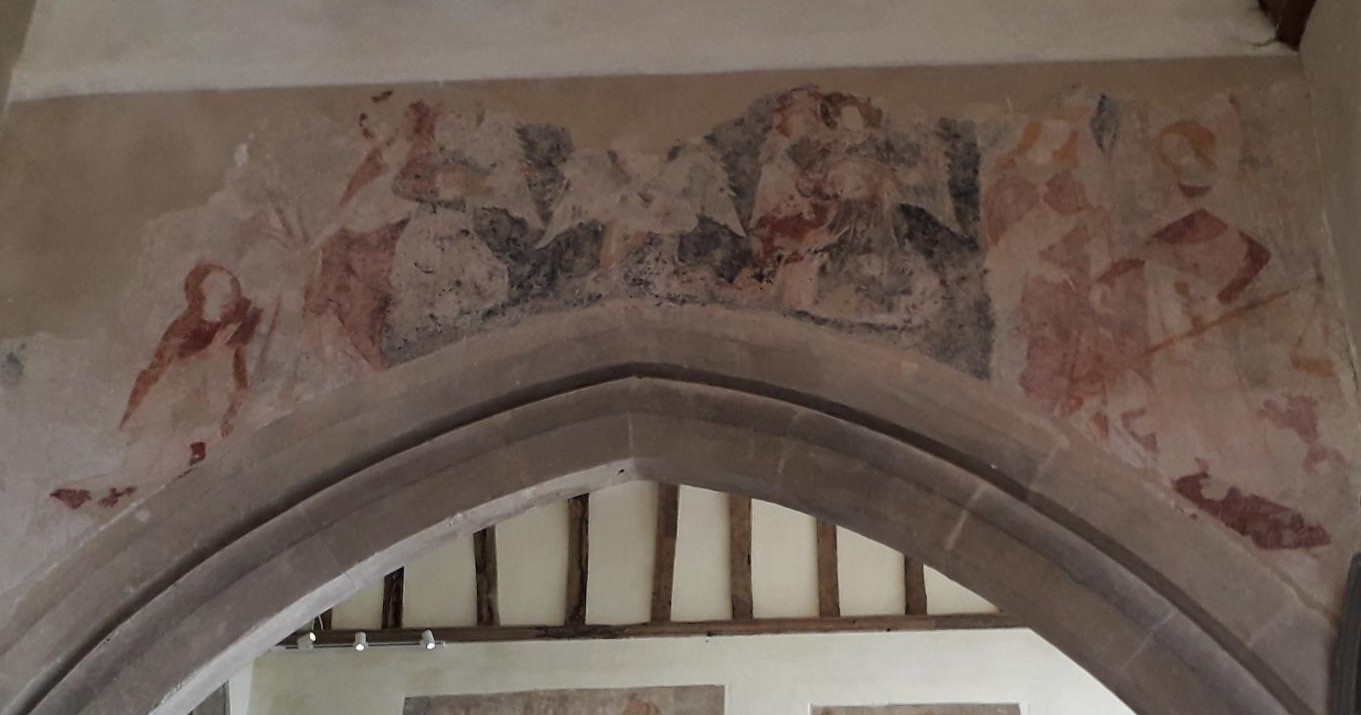
Above the arch are paintings one on top of another, each done at different times. They include a band of angels superimposed on an earlier painting. To the left is a kneeling Mary Magdalen and a standing Christ. This represents the scene in the garden on the first Easter morning. Mary reaches out her hands to the risen Lord who says, ‘Touch me not, for I am not yet ascended.’ To the right are two standing figures. One is the Virgin Mary and the other St Michael the Archangel. St Michael holds a balance; he is weighing souls to judge whether they are worthy of heaven. Mary reaches out a finger to ‘tip the balance’ to help souls into heaven.
Anecdote
The wall paintings in this Church were first restored in 1947 by Professor Tristram. He cleaned them using wax as a fixative, a method found to have disastrous results, as it traps moisture in the wall and darkens with age. In 1978 there was further restoration. A team, led by Mrs Eve Baker a former pupil of the Professor Tristram, cleaned the wax away and consolidated the plaster with repeated applications of lime water, filing cracks with new plaster made to the ancient formula.
Bible Reading