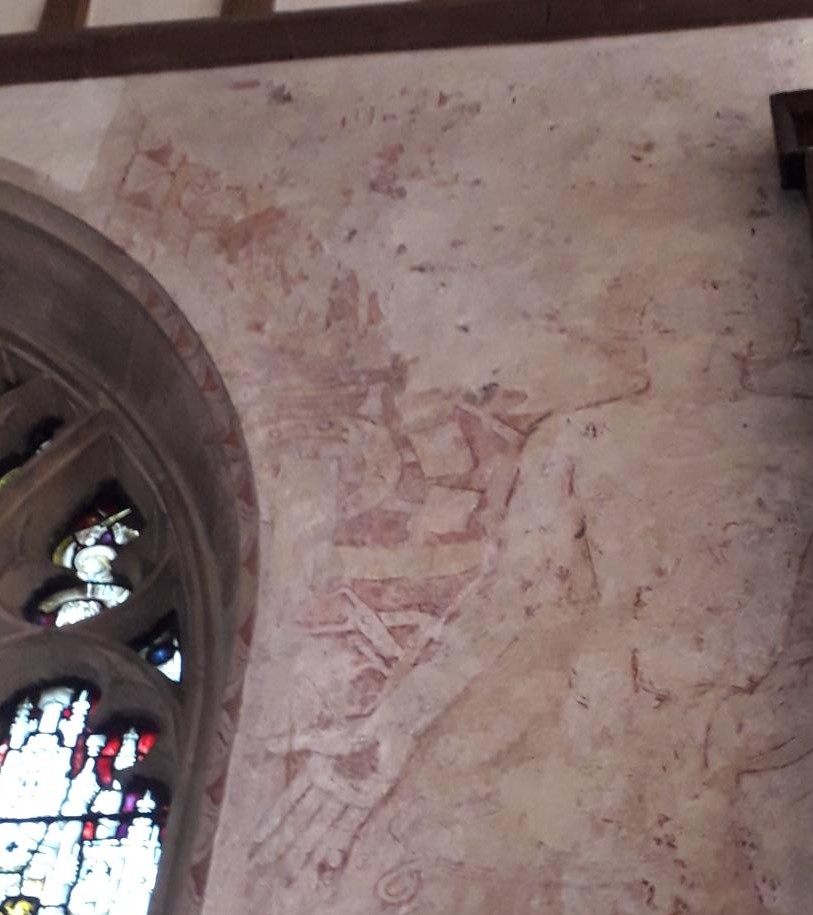
Wall paintings on south wall - Ascension of Jesus
On one occasion, while he was eating with them, he gave them this command: “Do not leave Jerusalem, but wait for the gift my Father promised, which you have heard me speak about. For John baptized with water, but in a few days you will be baptized with the Holy Spirit.” Then they gathered around him and asked him, “Lord, are you at this time going to restore the kingdom to Israel?” He said to them: “It is not for you to know the times or dates the Father has set by his own authority. But you will receive power when the Holy Spirit comes on you; and you will be my witnesses in Jerusalem, and in all Judea and Samaria, and to the ends of the earth.” After he said this, he was taken up before their very eyes, and a cloud hid him from their sight. They were looking intently up into the sky as he was going, when suddenly two men dressed in white stood beside them. “Men of Galilee,” they said, “why do you stand here looking into the sky? This same Jesus, who has been taken from you into heaven, will come back in the same way you have seen him go into heaven.”
On the walls are rare medieval wall paintings. Five hundred years ago St Mary’s would have been very colourful. The walls, stonework and pillars were painted with scenes from the Bible, lives of the saints or stories from popular legend. Few people could read, so pictures reminded parishioners of the Church’s teachings. Whitewash covered the paintings during the Reformation and three hundred years later the Victorian restorers stripped the interior plaster, leaving us with fragments that are rare, valuable and interesting. Fortunately, St Mary’s still possesses some ancient paintings.
Anecdote
To the west is a small square containing a painted head and hand. On the east side of the South Door high up is painting of the walls of Jerusalem and a very well-preserved figure of St Peter, complete with triple crown and keys. Below is an immense figure of the wounded Christ, surrounded by the tools of medieval tradesmen. This ‘Christ of the Trades’ is a not unfamiliar subject of medieval wall paintings. The body of Christ has many streaming wounds. The ‘millwheel’ is probably a medieval idea of a perpetual motion machine, perhaps symbolic of the continued suffering of Christ caused by man’s inhumanity to man. Just above the wheel and tools, can be seen the bodies of men and women floating up to St Peter and Jerusalem above.
Bible Reading